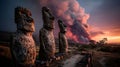
This group of heads, Moai, at Ahu Akivi. The moai are monolithic statues, and their minimalist style reflects forms found throughout Polynesia. Moai are carved from volcanic tuff (solidified ash). The human figures would be outlined in the rock wall first, then chipped away until only the image was left. The over-large heads (a three-to-five ratio between the head and the trunk, a sculptural trait consistent with the Polynesian belief in the sanctity of the chiefly head) have heavy brows and elongated noses with a distinctive fish-hook-shaped curl of the nostrils. The lips protrude in a thin pout. Like the nose, the ears are elongated and oblong in form. The jaw lines stand out against the truncated neck. The torsos are heavy, sometimes, the clavicles are subtly outlined in stone too. The arms are carved in bas relief and rest against the body in various positions, hands and long slender fingers resting along the crests of the hips, meeting at the hami (loincloth), with the thumbs sometimes pointing towards the navel. Generally, the anatomical features of the backs are not detailed, but sometimes bear a ring and girdle motif on the buttocks and lower back. Except for one kneeling moai, the statues do not have clearly visible legs. Mo?ai quarry at Rano Raraku. Though moai are whole-body statues, they are often referred to as "Easter Island heads" in some popular literature. This is partly because of the disproportionate size of most moai heads, and partly because many of the images for the island showing upright moai are of the statues on the slopes of Rano Raraku, many of which are buried to their shoulders. Some of the "heads" at Rano Raraku have been excavated and their bodies seen, and observed to have markings that had been protected from erosion by their burial. The average height of the moai is about 4 m (13 ft), with the average width at the base around 1.6 m (5.2 ft). These massive creations usually weigh around 12.5 tonnes (13.8 tons) each. All but 53 of the more than 900 moai known to date were carved from tuff (a compressed volcanic ash) from Rano Raraku, where 394 moai in varying states of completion are still visible today. There are also 13 moai carved from basalt, 22 from trachyte and 17 from fragile red scoria.[15] At the end of carving, the builders would rub the statue with pumice.
|