biconcave

navigate by keyword : wheel views view unique thickness thickening text surface structural shows shape red provide presentation organ nose morphology micrometers micrometer line labels labeled human highlights head hand generated gas font features face eye exchange erythrocyte enhancing efficient edge ear drawing disc dimensions diameter diagram detailed depression curvature crosssectional circle characteristics central center cellular cells cell cartoon brand blood biconcave arm area

(erythrocytes), depicted as biconcave disks in shades of red. Royalty Free Stock Photo
They are depicted in a cluster, showing their biconcave disc Royalty Free Stock Photo
Appear with a smooth, biconcave structure typical of healthy Royalty Free Stock Photo
As smooth, biconcave discs without visible nuclei, characteris Royalty Free Stock Photo
Cells are depicted in a biconcave shape, varying in size, with a Royalty Free Stock Photo
Cells are depicted as biconcave, disc-shaped structures, appearing Royalty Free Stock Photo
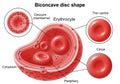
Erythrocyte illustration highlighting its biconcave disc shape Royalty Free Stock Photo
Highlights the biconcave disc curvature, enhancing the cell s
Normal biconcave red cells, misshaped cells, molecular structures, Royalty Free Stock Photo
As prominent, circular, and biconcave, while the white cells are Royalty Free Stock Photo
Diagram illustrating the biconcave disc shape of a red blood cell Royalty Free Stock Photo
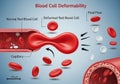
In a flexible, biconcave shape as they adjust to the changing Royalty Free Stock Photo
Red blood cells (erythrocytes), depicted in a biconcave shape, Royalty Free Stock Photo
Cells are shown as biconcave discs, white blood cells as larger, irregular Royalty Free Stock Photo
Blood cells, point mutations in -globin, and normal biconcave Royalty Free Stock Photo
Illustration of a biconcave disc cell, specifically a human red blood cell (erythrocyte). The diagram shows the cell's unique shape with a central depression, labeled dimensions, and structural features. The diameter is 7-8 micrometers with a 1 micrometer thickness at the center, thickening to 2 micrometers at the edge. The cross-sectional view highlights the biconcave disc curvature, enhancing the cell's surface area for efficient gas exchange. Different views and labels provide detailed cellular morphology characteristics.


Stockphotos.ro (c) 2026. All stock photos are provided by Dreamstime and are copyrighted by their respective owners.