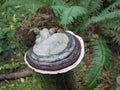
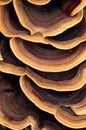
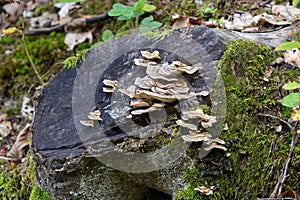
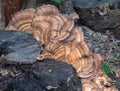
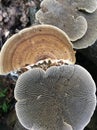
olypores are a group of fungi that form large fruiting bodies with pores or tubes on the underside (see Delimitation for exceptions). They are a morphological group of basidiomycetes-like gilled mushrooms and hydnoid fungi, and not all polypores are closely related to each other. Polypores are also called bracket fungi or shelf fungi, and they characteristically produce woody, shelf- or bracket-shaped or occasionally circular fruiting bodies that are called conks.[1]Most polypores inhabit tree trunks or branches consuming the wood, but some soil-inhabiting species form mycorrhiza with trees. Polypores and the related corticioid fungi are the most important agents of wood decay, playing a very significant role in nutrient cycling and aiding carbon dioxide absorption by forest ecosystems.[2]Over one thousand polypore species have been described to science,[3] but a large part of the diversity is still unknown even in relatively well-studied temperate areas. Polypores are much more diverse in old natural forests with abundant dead wood than in younger managed forests or plantations. Consequently, a number of species have declined drastically and are under threat of extinction due to logging and deforestation.Polypores are used in traditional medicine, and they are actively studied for their medicinal value and various industrial applications. Several polypore species are serious pathogens of plantation trees and are major causes of timber spoilage.Trametes versicolor, a colorful bracket fungus, commonly known as turkey tail[4]A bracket fungus (Pycnoporus sp.) with a tough, woody capThe blushing bracket showing the red bruising, which is one identification characteristic[4]Laetiporus sulphureusBracket fungus on tree in Tokyo, JapanConks, the fruiting bodies of polypores, lie in a close planar grouping of separate or interconnected horizontal rows. Brackets can range from only a single row of a few caps, to dozens of rows of caps that can weigh several hundred pounds. They are mainly found on trees (living and dead) and coarse woody debris, and may resemble mushrooms. Some form annual fruiting bodies while others are perennial and grow larger year after year. Bracket fungi are typically tough and sturdy and produce their spores, called basidiospores, within the pores that typically make up the undersurface.
|